

![United States Department of Justice [DOJ]](/sites/default/files/styles/max_325x325/public/2022-08/1200px-Seal_of_the_United_States_Department_of_Justice.svg-1130544730.png?itok=7Vfz5Vql "United States Department of Justice [DOJ]")
Date of Offense
Reporting Authority
Supporting Document(s)
Statement
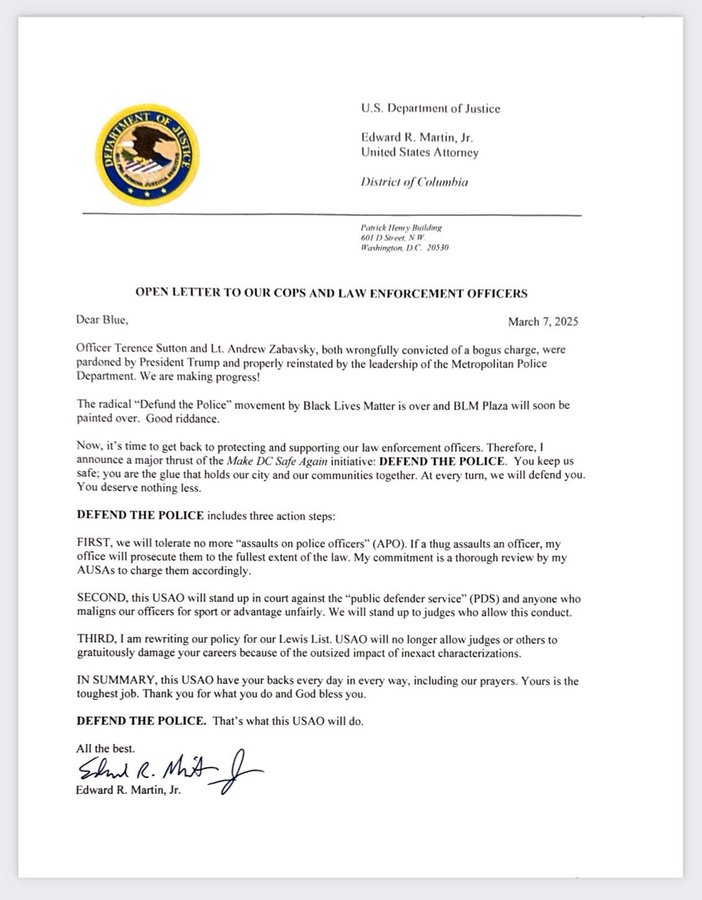
The letter issued by U.S. Attorney Edward R. Martin Jr. raises grave constitutional and ethical concerns. The most alarming element is the explicit directive that no judge or authority may place federal agents on the Lewis List (Washington D.C.'s version of the Brady List), which is fundamentally at odds with the Brady Doctrine, Giglio v. United States, and broader constitutional principles governing criminal prosecutions.
Why This Constitutes Prosecutorial Misconduct
1. Violation of Brady v. Maryland (373 U.S. 83, 1963):
Under the Brady Rule, the prosecution has a constitutional duty to disclose exculpatory evidence—that is, evidence favorable to the accused and material to guilt or punishment. This includes information that could impeach the credibility of a government witness, such as a police officer with a known history of dishonesty.
Explanation: If an officer has a record of lying, falsifying reports, using excessive force, or engaging in racial bias, this information may cast doubt on their testimony. Withholding it violates the defendant’s Due Process rights under the Fifth and Fourteenth Amendments.
2. Violation of Giglio v. United States (405 U.S. 150, 1972):
Giglio expanded Brady by holding that prosecutors must also disclose impeachment evidence, including any promises, deals, or credibility concerns related to government witnesses. Prosecutors are obligated to ensure that law enforcement officers with known credibility issues are disclosed to the defense.
Explanation: Preventing the placement of officers on the Lewis List directly obstructs this disclosure duty. It constitutes intentional suppression of impeachment evidence, which is prosecutorial misconduct.
3. Interference with Judicial Independence and Ethical Oversight:
By forbidding judges from placing officers on the Lewis List, the letter infringes on judicial discretion and impedes transparency mechanisms designed to prevent miscarriages of justice. The Lewis List functions to identify officers whose credibility may be compromised. Restricting its use shields these individuals from scrutiny and undermines the adversarial process.
Explanation: This represents a separation of powers violation and an abuse of prosecutorial discretion aimed at suppressing legally mandated disclosures.
4. Threatening Judges and Defense Counsel Violates the Rule of Law:
The letter states that the U.S. Attorney’s Office (USAO) will oppose judges and defense attorneys who “malign our officers” or place them on lists like Lewis or Brady. Such language is deeply troubling. It reflects an intent to chill the legitimate oversight functions of the judiciary and to punish adversaries for performing constitutionally protected roles.
Explanation: This smacks of vindictive prosecution, a well-established form of prosecutorial abuse, and undermines the fairness of criminal trials.
Conclusion
The directive issued in this letter is not merely a policy preference—it is a constitutional violation that reflects prosecutorial misconduct of the highest order. It undermines the Due Process rights of defendants, violates Brady and Giglio obligations, interferes with judicial authority, and represents a dangerous politicization of the prosecutorial role.
Authorities
Brady v. Maryland, 373 U.S. 83 (1963)
Giglio v. United States, 405 U.S. 150 (1972)
Kyles v. Whitley, 514 U.S. 419 (1995)
ABA Criminal Justice Standards for the Prosecution Function (Standard 3-5.4, 3-6.2)
D.C. Rules of Professional Conduct, Rule 3.8 (Special Responsibilities of a Prosecutor)


