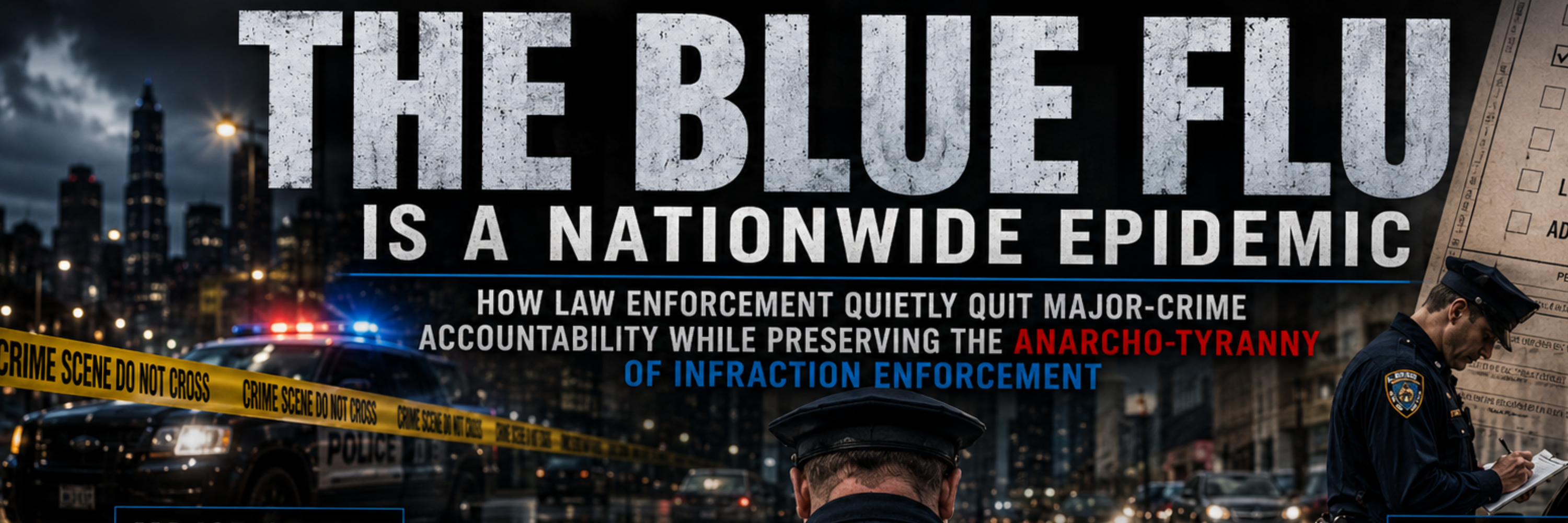
How Law Enforcement Quietly Quit Major-Crime Accountability While Preserving the Anarcho-Tyranny of Infraction Enforcement
The Blue Flu is usually described as a police labor tactic: officers calling in sick, slowing down work, or withdrawing services to protest oversight, discipline, budget pressure, public criticism, or political reform. That definition is now too small. The modern Blue Flu is not merely absenteeism. It is institutional quiet quitting.
Law enforcement has not disappeared. It has become selective.
We have crime and we need law enforcement; but,the law enforcement we have is not the law enforcement we need.
Across the country, many law-enforcement organizations continue to exercise the visible power of the state: traffic stops, citations, warrant service, contempt-style encounters, administrative enforcement, code enforcement referrals, public-order policing, and low-level arrests. Yet the same systems often appear materially less capable, less willing, or less interested in the hard work of major-crime investigation: witness development, evidence preservation, complete reporting, follow-up investigation, domestic-violence intervention, sexual-assault investigation, public-corruption detection, organized-crime work, officer-misconduct disclosure, and the production of constitutionally reliable cases.
That is the modern Blue Flu: not the abandonment of coercion, but the abandonment of accountability.
A police agency that stops investigating serious crime while continuing to enforce infractions has not “de-policed.” It has reallocated policing away from public safety and toward institutional convenience. It has preserved the functions that are easiest to count, easiest to monetize, easiest to defend, and easiest to impose upon ordinary people. It has withdrawn from the functions that require competence, candor, patience, supervision, and constitutional discipline.
This is not a morale problem. It is a governance problem.
The False Narrative of De-Policing
The public is often told that officers have pulled back because they are demoralized, criticized, underfunded, or afraid of being accused of misconduct. That argument has become the preferred institutional explanation for failures in public safety. It converts the police into victims of accountability and casts the public as responsible for the collapse of the very services it funds.
But the claim is incomplete. If officers were truly withdrawing from enforcement, the public would see a broad reduction in coercive police activity. Instead, in many communities, the most visible parts of enforcement remain intact. Drivers are still stopped. Warrants are still served. Fines are still imposed. Probationers and parolees are still searched. Homeless people are still displaced. Poor people are still processed through municipal enforcement systems. Technical violations still become criminal exposure. Minor contacts still escalate into arrest.
The withdrawal is not from enforcement generally. The withdrawal is from the difficult parts of enforcement.
The distinction matters. Major-crime investigation is labor-intensive and accountability-intensive. It requires officers to document what they saw, what they did, what they omitted, whom they interviewed, what evidence was preserved, what evidence was lost, and what alternative suspects or explanations were considered. It requires supervisors to review files. It requires prosecutors to disclose weaknesses. It requires courts to confront whether the state’s case is constitutionally reliable.
Infraction enforcement does not impose the same burden. It generates statistics. It produces activity. It can be performed quickly, repeated constantly, and defended under broad claims of discretion. It creates contact with the public without requiring meaningful investigative success. It is the preferred terrain of bureaucratic policing because it allows the agency to appear active while avoiding the most demanding obligations of public safety.
That is why the Blue Flu is so dangerous. It does not announce itself as a strike. It presents itself as discretion.
Anarcho-Tyranny in Uniform
The modern Blue Flu is best understood through the framework of anarcho-tyranny.
Anarcho-tyranny describes a system in which government fails to control actual disorder while remaining aggressive against the ordinary citizen. It is an inversion of legitimate government. The state becomes weak where it should be strong and strong where it should be restrained.
In law enforcement, the “anarchy” appears when major crimes are not meaningfully investigated, victims are ignored, witnesses are not developed, cases are not cleared, evidence is not preserved, investigative files are incomplete, and officers avoid the work necessary to produce reliable prosecutions. Communities experience violence, theft, assault, exploitation, trafficking, domestic abuse, and public disorder without receiving competent state protection.
The “tyranny” appears when that same system remains fully capable of enforcing low-level offenses against the public. The state may fail to solve shootings, burglaries, assaults, organized theft, or corruption, but it still has energy for expired registration, municipal fines, nuisance enforcement, license suspensions, bench warrants, failure-to-appear cycles, contempt, and procedural punishment.
That is the constitutional insult. The public receives neither safety nor liberty.
An agency that cannot clear serious cases but can aggressively pursue infractions is not under-policing. It is selectively policing. It has chosen the path of least institutional resistance. It has preserved the authority to impose consequences while abandoning the duty to solve crimes.
Major-Crime Investigation Is the Core Public-Safety Function
The legitimacy of policing does not come from the number of stops made, tickets written, arrests booked, or warrants served. It comes from the ability to protect the public through lawful, competent, truthful, and constitutionally disciplined investigation.
Major-crime investigation is the core test of a law-enforcement organization. It tests whether officers can identify suspects without fabricating certainty. It tests whether they can interview witnesses without coercion. It tests whether they can preserve evidence without contamination. It tests whether they can document uncertainty. It tests whether they can disclose credibility problems. It tests whether supervisors can correct weak cases before prosecutors inherit them. It tests whether the agency is a public-safety institution or merely an armed bureaucracy.
When that function collapses, the consequences are not abstract. Victims are abandoned. Innocent people become easier to accuse. Guilty people remain free. Prosecutors receive incomplete cases. Defense counsel receives incomplete discovery. Judges are asked to rule on distorted records. Communities lose confidence in both policing and courts.
Clearance rates matter because they reveal whether the system is solving reported crimes. But clearance rates are only one measure. The deeper problem is investigative integrity. A case can be “cleared” badly. A person can be arrested on weak evidence. A confession can be coerced. A witness can be coached. A report can omit exculpatory facts. A prosecutor can proceed because the file looks complete when it is not.
The Blue Flu therefore has two forms. The first is non-investigation: doing too little. The second is bad investigation: doing enough to create a prosecution but not enough to create a reliable prosecution. Both forms are constitutionally dangerous.
The Brady/Giglio Consequence
The Blue Flu is a Brady/Giglio problem.
Brady requires the prosecution to disclose material exculpatory evidence. Giglio requires disclosure of impeachment evidence affecting the credibility of government witnesses. Those obligations cannot function when law enforcement quietly refuses to create, preserve, document, or transmit the factual record necessary for disclosure.
A missing investigation can be exculpatory. An abandoned lead can be exculpatory. A witness not interviewed can be exculpatory. A surveillance video not collected can be exculpatory. A delayed report can be exculpatory. A contradiction between officers can be exculpatory. A supervisor’s failure to review a file can be exculpatory. A known officer credibility issue can be exculpatory. A pattern of low-quality investigations within a department can be exculpatory.
The constitutional problem is not limited to evidence that exists in a folder. It includes the state’s failure to preserve evidence, the state’s failure to document investigative choices, and the state’s failure to disclose weaknesses known to police, prosecutors, or the agency’s internal systems.
Where officers quietly quit major-crime investigation, they do not merely reduce productivity. They create disclosure failures. They create evidentiary gaps. They create uncertainty that is often hidden from defendants, courts, and the public. They create cases where the official record appears cleaner than the truth.
That is why police nonperformance must be treated as potential impeachment evidence. If an officer, squad, unit, or department has a pattern of failing to investigate serious crime while maintaining infraction enforcement, that pattern bears directly on bias, motive, competence, credibility, and the reliability of testimony.
A prosecutor cannot satisfy Brady by pretending the police file is complete. A judge cannot satisfy due process by assuming the investigation was competent. A defense attorney cannot provide effective assistance without access to the investigative defects that shaped the case.
The Blue Flu is therefore not outside the criminal case. It is inside the criminal case.
Selective Enforcement as Institutional Misconduct
Selective enforcement is often discussed as discrimination: different people receiving different treatment based on race, class, viewpoint, neighborhood, or political status. That remains true. But the modern Blue Flu adds another layer: different categories of crime receive different institutional commitment based on convenience, risk, and bureaucratic reward.
The system remains energetic where enforcement is easy. It becomes passive where enforcement is hard.
This is institutional misconduct because the agency is not free to redefine its mission around convenience. Police departments exist to protect the public, investigate crime, preserve evidence, support lawful prosecution, and provide truthful information to the justice system. When they maintain coercive enforcement but abandon serious investigation, they breach the basic public trust attached to their authority.
That breach is especially severe because law enforcement holds a monopoly on the first layer of criminal fact creation. Police decide what gets written down. Police decide what leads are followed. Police decide what evidence is preserved. Police decide what witnesses are identified. Police decide what version of events reaches the prosecutor. Police decide whether internal credibility problems are treated as disclosure material or buried as personnel information.
When police quietly quit that function, the entire justice system receives a corrupted input.
This is why the issue cannot be solved by telling the public to respect police more. Public respect is not the cause of constitutional reliability. Candor is. Documentation is. Disclosure is. Supervision is. Discipline is. The public does not owe confidence to an agency that refuses to prove its work.
Infraction Enforcement as Bureaucratic Survival
Low-level enforcement survives because it serves the bureaucracy.
Infraction enforcement creates measurable output. It supports claims of productivity. It produces contacts, stops, citations, fines, fees, warrants, and compliance statistics. It can be automated, repeated, and defended as routine. It also creates an appearance of public order without requiring the agency to solve the underlying problems that make communities unsafe.
For municipalities, infraction enforcement may also create financial incentives. Fines, fees, court costs, impound charges, probation costs, and related penalties can transform low-level enforcement into a revenue-adjacent system. Even when a department denies revenue motives, the machinery of enforcement often imposes financial consequences on the public while shielding the agency from deeper performance scrutiny.
The public then experiences government as punishment without protection.
This is the bureaucratic logic of anarcho-tyranny. The system cannot or will not solve major crimes, but it can still punish small violations. It cannot protect neighborhoods from serious harm, but it can still burden the poor, the mobile, the politically weak, and the administratively vulnerable. It cannot prove public safety success, but it can produce enforcement activity.
That activity is then mistaken for legitimacy.
The Collapse of Candor
The Blue Flu also reflects a collapse of candor.
Complete candor is the first duty of every officer because every criminal case depends on the officer’s truthfulness. A police report is not just paperwork. It is the foundation of the prosecution’s factual claim. A missing fact can alter probable cause. A hidden contradiction can alter credibility. An omitted witness can alter guilt. A delayed disclosure can alter trial strategy. A false statement can destroy the integrity of the case.
Quiet quitting attacks candor indirectly. It allows officers to avoid lying by avoiding work. It allows agencies to avoid disclosure by avoiding documentation. It allows prosecutors to avoid bad facts by never receiving them. It allows judges to avoid constitutional confrontation because the record presented to the court has already been sanitized by omission.
This is why omission must be treated as seriously as affirmative falsehood. A justice system can be corrupted by what officers do not write, do not collect, do not ask, do not preserve, and do not disclose. A police file that omits the real weaknesses of the investigation is not neutral. It is a curated instrument of prosecution.
The Brady problem is therefore structural. The state cannot disclose what the police refuse to document. The defense cannot test what the state refuses to preserve. The court cannot remedy what the record conceals.
Measuring the Blue Flu
The modern Blue Flu should be measured as an institutional pattern, not dismissed as anecdote.
Relevant indicators include declining clearance rates, unresolved major-crime backlogs, delayed report completion, increased case dismissals for weak evidence, failure to collect digital evidence, failure to canvass witnesses, failure to test forensic material, body-camera gaps, refusal to identify officers, repeated discovery violations, high rates of prosecutor declinations, citizen complaints about nonresponse, and agency resistance to public records disclosure.
Another critical indicator is the enforcement split: whether the agency remains active in low-level enforcement while major-crime accountability declines. A department that claims staffing shortages for homicide follow-up but maintains aggressive traffic enforcement has made a policy choice. A department that claims morale problems when asked to investigate misconduct but remains capable of nuisance enforcement has made a policy choice. A department that claims resource scarcity while preserving militarized equipment, public-relations staff, and political lobbying has made a policy choice.
The question is not whether officers are busy. Bureaucracies can always appear busy. The question is whether the agency is performing the constitutional work that justifies its authority.
Prosecutors Cannot Ignore the Blue Flu
Prosecutors have a direct duty to confront this problem.
The prosecution is responsible for the constitutional integrity of the case. That responsibility cannot be outsourced to police. If law enforcement provides incomplete files, suppresses credibility material, fails to document investigative gaps, or quietly abandons major-crime investigation, prosecutors must treat those defects as disclosure issues and case-integrity issues.
A prosecutor who proceeds on a police file without examining whether the investigation was materially incomplete risks turning police nonperformance into prosecutorial misconduct. The prosecutor may not have caused the investigative failure, but the prosecutor owns the decision to use the resulting case.
That means prosecutors must ask harder questions. What leads were not pursued? What witnesses were not interviewed? What evidence was not collected? What officer credibility issues exist? What reports were delayed? What supervisory review occurred? What body-camera footage is missing? What internal affairs history affects the involved officers? What agency-wide practices affect the reliability of the investigation?
The answer cannot be, “That is all the police gave us.” Brady does not end at the edge of the prosecutor’s desk.
Judges Cannot Pretend the Record Is Neutral
Judges also have a duty to stop treating police-generated records as presumptively reliable.
A criminal case reaches the court only after the state has selected, summarized, and formalized the facts it wants to present. If the underlying police culture is one of selective enforcement, incomplete investigation, and disclosure avoidance, the court record is not a neutral record. It is a filtered product of state power.
Judicial silence allows the Blue Flu to become normalized. When judges deny discovery, tolerate late disclosure, excuse missing evidence, credit boilerplate police reports, and refuse to examine agency-wide credibility problems, they convert institutional nonperformance into admissible prosecution evidence.
The court’s role is not to protect the administrative convenience of police and prosecutors. The court’s role is to protect constitutional adjudication. That requires skepticism where the investigative record is incomplete, where officer credibility is impaired, or where agency patterns suggest systemic disclosure failure.
A judiciary that refuses to confront the Blue Flu becomes part of it.
The Public-Safety Fraud
The phrase “public safety” is now used too casually. Government invokes public safety to justify budgets, surveillance, weapons, immunity, emergency powers, special statutes, enhanced penalties, and deference. But public safety is not a slogan. It is a performance obligation.
A law-enforcement agency that cannot solve serious crime but can still punish technical violations is not delivering public safety. It is delivering public control.
A law-enforcement agency that hides officer misconduct while demanding public trust is not delivering public safety. It is delivering institutional protection.
A law-enforcement agency that produces arrests without reliable investigations is not delivering public safety. It is delivering prosecution volume.
A law-enforcement agency that uses discretion to avoid hard cases and coercion to pursue easy cases is not delivering public safety. It is delivering anarcho-tyranny.
That is the fraud at the center of the modern Blue Flu. The public is told to fund the system because it provides safety, then told to accept nonperformance because the system feels criticized. Meanwhile, the system keeps the power, keeps the budget, keeps the weapons, keeps the pensions, keeps the legal protections, and keeps the authority to impose consequences on the public.
No public institution is entitled to that bargain.
The Brady List Response
The Blue Flu requires an external record.
Internal police systems are not sufficient. Prosecutor-maintained disclosure lists are not sufficient when they remain hidden, discretionary, incomplete, or dependent on voluntary agency reporting. Judicial assumptions are not sufficient. Public trust is not sufficient. The constitutional system requires a public-facing mechanism capable of identifying the officers, agencies, prosecutors, and courts that participate in disclosure failure, investigative nonperformance, credibility impairment, and selective enforcement.
That is the role of the Brady List.
The Brady List treats credibility as a public-safety issue, a due-process issue, and a constitutional disclosure issue. It rejects the false premise that officer misconduct is merely an internal employment matter. It recognizes that every officer who testifies, writes reports, signs probable-cause statements, handles evidence, supervises investigations, or shapes prosecution files can affect the liberty of the accused and the safety of the public.
The Blue Flu expands the importance of that work. If the problem is not isolated misconduct but institutional quiet quitting, then officer-by-officer accountability must be paired with agency-level scrutiny. A department that abandons major-crime accountability while preserving infraction enforcement is itself a Brady/Giglio concern. Its patterns affect every case it touches.
Conclusion: No Safety Without Candor
The modern Blue Flu is not a legitimate protest. It is not ordinary discretion. It is not merely a staffing problem. It is the selective withdrawal of public-safety labor by institutions that continue to exercise public-control power.
That condition must be named clearly.
When law enforcement stops doing the hard work of investigating major crime but continues the easy work of enforcing infractions, the result is anarcho-tyranny. When officers fail to document, preserve, disclose, and testify with complete candor, the result is Brady collapse. When prosecutors proceed without confronting those defects, the result is prosecutorial misconduct. When judges tolerate incomplete records and hidden credibility problems, the result is judicial complicity.
The public does not owe deference to a system that has quietly quit its constitutional function.
Law enforcement has one legitimate claim to authority: the faithful, lawful, truthful, and competent protection of the public. If an agency cannot investigate serious crime, cannot disclose impeachment evidence, cannot preserve exculpatory material, cannot supervise its officers, and cannot tell the truth in court, then it has forfeited the moral foundation of its power.
The Blue Flu is not just a police problem.
It is a nationwide epidemic of selective enforcement, institutional concealment, and constitutional failure.


